Ants in your plants! How ants support native flora (and vice versa)
By Lise Fracalossi
Before you squish that ant you find crawling on your native plant, consider this: ants play a vital role in supporting native plants.
How? Read on!
Myrmecophytes
The word for a plant that has a symbiotic relationship with ants is a “myrmecophyte.” This is just a conglomeration of the Greek words for “ant” and “plant.”
That relationship can take a number of different forms. In ecological terms, they are often mutualisms, where both the ant and the plant benefit from the interaction. Sometimes they are commensalisms, where one party benefits while the other is unharmed.
Seed Dispersal
Many plants depend on ants to disperse their seeds. There’s a fancy Greek word for that, too: “myrmecochory” (literally “ant” and “circular dance.”) Theoretically myrmecochory could refer to any ant-plant interaction, but I usually only see it in the context of seed dispersal.
Myrmecochory is seen in a number of different native plants of New England. You’ll see it in many spring ephemeral wildflowers like trilliums (Trillium spp.), bloodroot (Sanguinaria canadensis), and spring beauties (Claytonia spp).
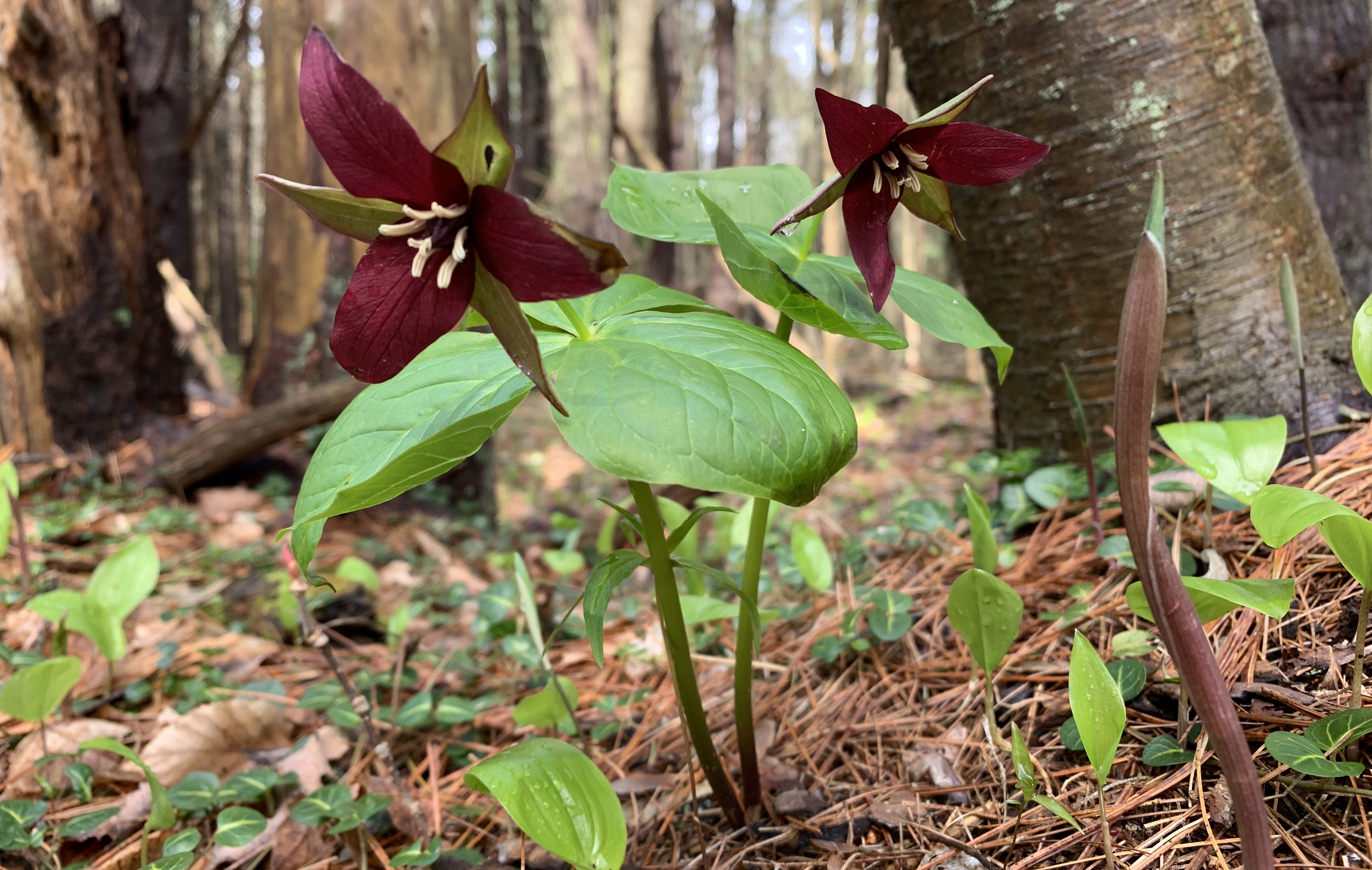
Red trillium (Trillium erectum) is one of the species that benefits from seed dispersal by ants. (Any excuse for a trillium pic, amirite, Lise?)
Photo by Lise Fracalossi - Own work, Public Domain
(While you’ll see myrmecochory with a variety of plants, it’s interesting to consider why this dispersal strategy might be so beneficial to spring ephemerals…)
How does this relationship work? The seeds of these plants have evolved to produce a fatty… chunk *, for lack of a better word, on the exterior of the seed called an elaiosome. (There’s some more Greek for you – it means “oil body”). The elaiosome is rich in fats, making it delicious to ants, who will seek it out as soon as the fruit becomes ripe. (If you are trying to collect seeds from the aforementioned plants, you’ll need to beat the ants to them!)
* (Coincidentally, “fatty chunk” is also what we call our cat Gussie 😂).

Seeds of prairie trillium (Trillium recurvatum). The dark circular piece is the seed itself, and the white lump attached to it is the elaiosome.
After the delicious part has been eaten, ants carry these seeds back to their middens – basically, their trash pile outside the nest. From there, new seeds can germinate! (The contents of the trash pile probably contain lots of nutrients that plants can benefit from, too).
So just think – any time you see a trillium, it’s probably growing on top of ant garbage!
Other ant-plant relationships
Another ant-plant interaction you’ll see in the northeast U.S. is with certain members of the legume/bean family Fabaceae, eg. Chamaecrista fasciculata (partridge pea).
In this relationship, the plant attracts ants with nectar produced by glands on the petiole (leaf stalk). The ants eat both the nectar and herbivorous pests that visit the plant. The plants are shown to take less damage from herbivore pests as a result of this interaction..
Thus: the ants get food; the plants get defense.
In partridge pea, these glands – called extrafloral nectaries – are visible as a red, upraised bump on the leaf petiole. Like so:

An extreme closeup on the extrafloral nectaries of partridge pea (Chamaecrista). They appear as red-brown bumps on the leaf stalk.
Outside of New England, further ant-plant interactions are seen! Several tropical/neotropical plants (such as acacia, cecropia, or balsa) produce food bodies which provide proteins, fats, or sugars to ants. Some plants even offer domatia – from the Latin for “house” – which are ideal for ants to excavate and live in.
“What about pollination, Lise?”
Pollination was probably the first thing you thought of when I said “ants” and “plants”, right? But ant pollination is less common than you might think!
Ants just are not very good pollinators, as most adults don’t have wings. Thus they can’t spread pollen as far as their cousins: bees and wasps. Pollination by ants, then, is mostly accidental.
That said, there is at least one orchid that is pollinated solely by an ant! It’s a winged male ant, however – giving it a much greater range than your typical one.
In closing
There are even more ant-plant interactions that I haven’t touched on here! The Wikipedia page for “myrmecophyte” is a fascinating read, if you crave more obscure botanical knowledge.
We often think of ants as “pests” – no one likes ants getting into their sugar bowl, after all, and almost any New England homeowner has had to deal with carpenter ants. But species are just labeled “pests” when they’re inconvenient to humans – a very anthropocentric view. These “pests” can still offer tremendous value to the web of life.
Or, as my Wildflowers of New England teacher, Neela de Zoysa, would say… “Even mosquitoes pollinate bog orchids.”
(Huh, maybe I need to write a post on pollination by Dipterans, i.e. flies, at some point… 🤔)
Featured image: A carpenter ant (genus Camponotus) on partridge pea (Chamaecrista fasciculata). Taken at Garden in the Woods, Framingham, MA, August 2022. Photo by Lise Fracalossi - Own work, Public Domain.